
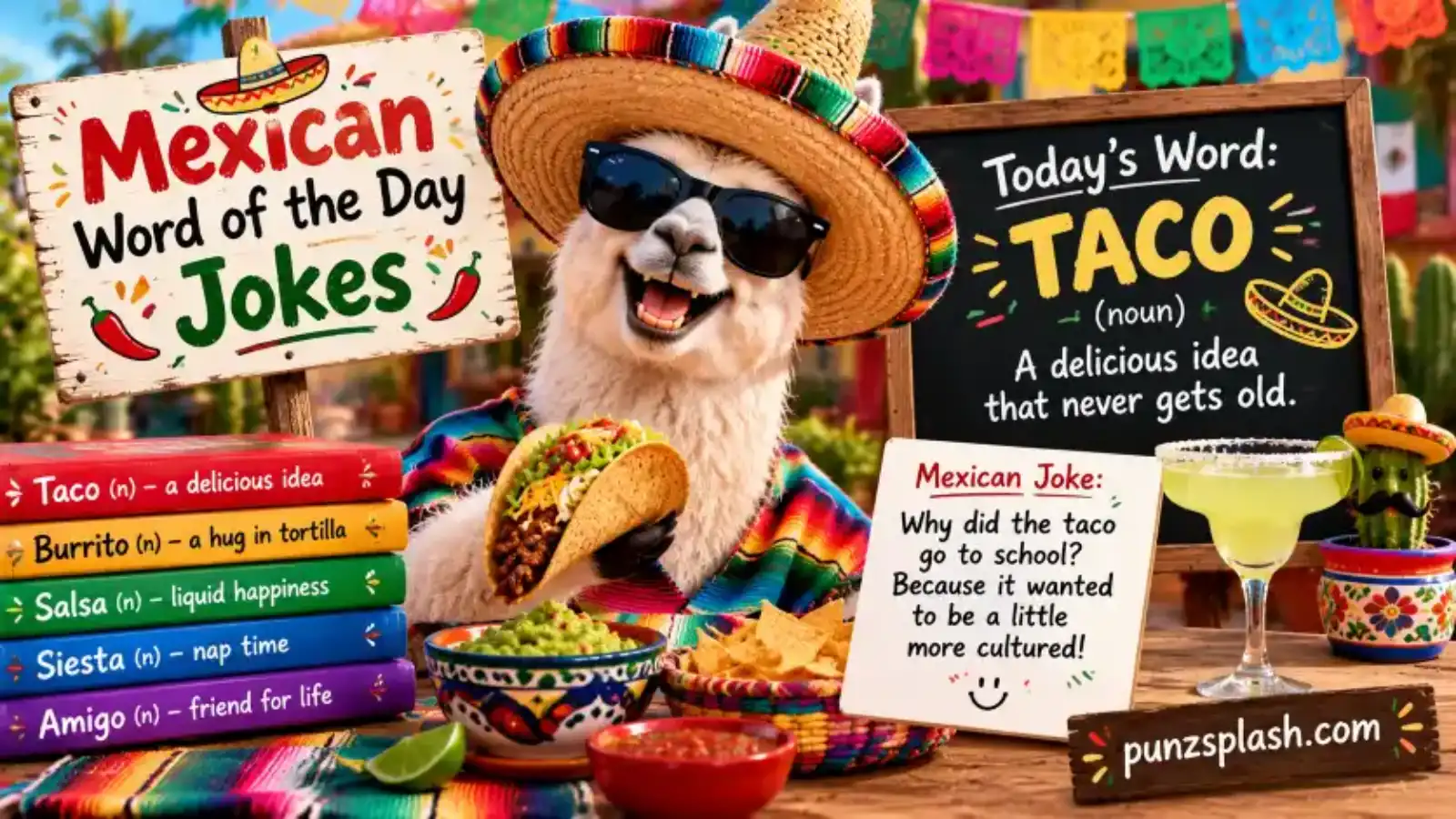
If you’ve ever learned a Spanish word and immediately tried to turn it into a joke, you already understand the appeal of Mexican word of the day jokes.
One tiny word can become a pun, a silly sentence, or a joke that gets an eye-roll from everyone at the table.
The best ones play with Spanish words, English sounds, translation, and everyday situations rather than making fun of Mexican people or culture. So this collection keeps the humor light, clean, and easy to share.
What Are “Mexican Word of the Day” Jokes?
The phrase usually refers to jokes built around a Spanish word—often presented as a playful “word of the day” with a funny English interpretation or punchline.
For example:
Palabra del día: “Gato.”
It means “cat.”
And apparently, it also means “the boss of your house.”
Simple wordplay is the whole game.
Funny Mexican Word of the Day Jokes
Here are some original, family-friendly examples you can use for texts, classroom humor, captions, or just making your friends groan.
1. “Hola”
Palabra del día: Hola.
It means “hello,” but it can also mean, “I walked into the wrong room and I’m pretending this was intentional.”
2. “Gracias”
Palabra del día: Gracias.
It means “thank you.”
The word you use after someone saves you from an awkward conversation.
3. “Amigo”
Palabra del día: Amigo.
It means “friend.”
The person who says, “I know a shortcut,” and somehow makes the trip longer.
4. “Familia”
Palabra del día: Familia.
It means “family.”
The people who know your embarrassing stories before you do.
5. “Comida”
Palabra del día: Comida.
It means “food.”
A word that needs no translation when you’re hungry.
6. “Agua”
Palabra del día: Agua.
It means “water.”
The thing you suddenly remember you should drink after eating something spicy.
7. “Casa”
Palabra del día: Casa.
It means “house.”
A place where “I’m going to bed early” goes to die.
8. “Perro”
Palabra del día: Perro.
It means “dog.”
Basically, a furry roommate who never pays rent.
9. “Gato”
Palabra del día: Gato.
It means “cat.”
A tiny landlord who charges you in food.
10. “Sol”
Palabra del día: Sol.
It means “sun.”
The reason your sunglasses suddenly become your most important accessory.
Spanish-English Wordplay That Deserves an Eye Roll
Sometimes the funniest joke is the one that makes everyone groan before someone secretly repeats it later.
11. “Pan”
Spanish: pan.
English: bread.
Either way, it’s a solid foundation for a sandwich.
12. “Luna”
Spanish: luna.
English: moon.
Finally, something that sounds almost as poetic as it looks.
13. “Mar”
Spanish: mar.
English: sea.
So if you say “mar” dramatically enough, you sound like you’re auditioning for a pirate movie.
14. “Rojo”
Spanish: rojo means “red.”
That’s easy to remember because stopping at a red light is also an excellent time to remember your Spanish homework.
15. “Verde”
Spanish: verde means “green.”
The color of grass, leaves, and the person who forgot the answer in Spanish class.
16. “Libro”
Spanish: libro means “book.”
A traditional device for learning things before someone says, “Just search it.”
17. “Mesa”
Spanish: mesa means “table.”
A perfectly useful word until someone asks you to clear it.
18. “Silla”
Spanish: silla means “chair.”
The furniture equivalent of saying, “I’ll just sit here for five minutes.”
19. “Zapato”
Spanish: zapato means “shoe.”
Because apparently “foot hat” was already taken.
20. “Puerta”
Spanish: puerta means “door.”
The thing standing between you and the snack you left in the kitchen.
Short Mexican Word of the Day One-Liners
Need something quick? These work well as texts, status updates, or classroom-friendly jokes.
- Palabra del día: “Sí.” It means yes—and apparently I say it before thinking.
- Palabra del día: “No.” The most powerful vocabulary word when your sibling asks for your snacks.
- Palabra del día: “Hola.” Five letters, one greeting, zero awkward handshakes.
- Palabra del día: “Adiós.” What I say when my battery hits 1%.
- Palabra del día: “Sueño.” It means “dream,” which is also what I have when someone says, “You can sleep in tomorrow.”
- Palabra del día: “Rápido.” It means “fast,” which is how quickly pizza disappears.
- Palabra del día: “Lento.” It means “slow,” which describes me before breakfast.
- Palabra del día: “Grande.” It means “big,” like my homework pile.
- Palabra del día: “Pequeño.” It means “small,” like the amount of free time I have.
- Palabra del día: “Feliz.” It means “happy,” like me when school gets canceled.
Food-Themed Spanish Word Jokes
Food gives Spanish vocabulary plenty of room for playful jokes.
“Taco”
Palabra del día: taco.
A food so good that explaining it feels unnecessary.
“Queso”
Palabra del día: queso.
It means “cheese,” which is already a pretty grate word.
“Arroz”
Palabra del día: arroz.
Rice in Spanish. One small word with a very large dinner résumé.
“Leche”
Palabra del día: leche.
It means “milk.”
A word that sounds much more sophisticated when pronounced correctly.
“Helado”
Palabra del día: helado.
It means “ice cream.”
Proof that vocabulary lessons can have excellent rewards.
“Pan”
Palabra del día: pan.
It means “bread.”
Put it next to almost anything and suddenly lunch has a plan.
Funny Spanish Words for Everyday Life
Learning vocabulary becomes easier when you connect it to things you already know.
“Escuela” — school.
A place where you learn Spanish words and then immediately forget one when the teacher calls on you.
“Trabajo” — work.
A word that somehow feels longer on Monday.
“Amigos” — friends.
The people most likely to turn a five-minute plan into a three-hour adventure.
“Tiempo” — time.
It moves very slowly during homework and extremely fast on weekends.
“Música” — music.
The reason cleaning your room suddenly feels like a concert.
“Risa” — laughter.
The universal response to a joke that was probably not as funny as you thought.
“Dormir” — to sleep.
An activity you appreciate much more when your alarm goes off.
“Cansado” — tired.
The official status of anyone who stayed up too late.
Clever “Word of the Day” Jokes for Captions
These are short enough for social media without turning your caption into a Spanish textbook.
- Spanish word of the day: felicidad. Translation: finding extra fries at the bottom of the bag.
- Word of the day: amigos. Translation: people who make bad ideas sound reasonable.
- Spanish lesson complete. My vocabulary is growing faster than my confidence.
- Palabra del día: descanso. Because every language learner needs a break.
- Learning Spanish one funny word at a time.
- Today’s vocabulary: comida. Suddenly, I’m fluent.
- Spanish word of the day: fiesta. Somehow, everyone knows this one.
- New Spanish word unlocked. My brain would like to request a software update.
- Me learning Spanish: “I know this word!”
My brain: “Do you?” - One new Spanish word today. That’s progress—and tomorrow I’ll try to remember it.
A Few Dad-Joke Style Spanish Puns
If your sense of humor runs on eye rolls, you’re in the right section.
Why did the Spanish word bring a dictionary?
Because it wanted to improve its vocabulary.
Why did the Spanish student sit near the window?
For better translation of the view.
What did the Spanish word say after learning English?
“Nice to meet you. We should compare notes.”
Why did the dictionary go to school?
It wanted to become a little more wordly.
What happens when two languages become friends?
They find a common vocabulary.
Why did the Spanish word get promoted?
It had excellent word ethic.
Why was the vocabulary notebook so confident?
It had all the right words.
What did one Spanish word say to another?
“Don’t translate me—I can explain myself.”
Why These Jokes Work
The humor comes from language contrast.
A Spanish word can sound familiar to an English speaker, have an unexpected translation, or create a funny connection with an everyday situation. That gives the joke a small surprise without needing an elaborate setup.
The strongest examples usually have three parts:
- A recognizable Spanish word
- A simple English explanation
- A twist that has little to do with the expected definition
For instance, “comida” simply means “food,” but turning it into a joke about being hungry creates the punchline.
That’s also why these jokes work well for Spanish learners. The vocabulary remains understandable instead of getting buried beneath a complicated joke.
Quick Tip: If you’re making your own word-of-the-day jokes, choose words you can connect to something people experience every day—food, school, friends, sleep, pets, or weekends.
Mexican Word of the Day Jokes for Spanish Learners
Humor can make vocabulary easier to remember.
Try turning a new word into a tiny mental picture:
“Perro” — dog
Imagine a dog demanding dinner at exactly 6 p.m.
“Casa” — house
Picture yourself finally getting home after a long day.
“Agua” — water
Think of reaching for a glass after exercising.
“Libro” — book
Picture a book sitting beside your homework, judging you silently.
“Amigo” — friend
Imagine your friend texting, “Are you free?” immediately followed by a suspiciously long explanation.
The joke doesn’t have to be brilliant. If it helps the word stick in your memory, it has done its job.
Keep the Humor Respectful
“Mexican word of the day” is often used online as a playful label for Spanish-language word jokes. It’s worth remembering that Spanish is a language spoken across many countries, while Mexican Spanish has its own vocabulary, slang, pronunciation, and cultural context.
A good joke targets the wordplay, not a nationality or ethnic group.
That distinction makes the humor more welcoming—and usually makes the jokes funnier, too.
If you’re sharing these with Spanish speakers, it’s also smart to check the meaning and regional usage of slang before using it. A word that’s harmless in one place can have a different tone somewhere else.
FAQs:
What are Mexican word of the day jokes?
They’re humorous jokes built around Spanish vocabulary, often using a Spanish word followed by a funny English explanation or unexpected punchline.
Are these jokes actually Mexican?
Not necessarily. Many use general Spanish vocabulary rather than specifically Mexican Spanish. Mexican Spanish also has regional expressions that aren’t universal across the Spanish-speaking world.
Are these jokes appropriate for kids?
The examples in this collection are clean and family-friendly. They’re suitable for casual classroom humor, language practice, and general sharing.
Can I use these jokes to learn Spanish?
Absolutely. Simple jokes can help you connect vocabulary with memorable situations. Just remember that jokes are a supplement to proper language learning, not a replacement for it.
What’s a good Spanish word for a word-of-the-day joke?
Start with common words such as hola, gracias, amigo, familia, comida, agua, casa, perro, gato, or sol. Familiar words are easier to turn into understandable jokes.
How can I make my own Spanish word jokes?
Pick a Spanish word, write its real meaning, then find an unexpected connection with everyday life. Keep the punchline short and make sure the Spanish usage is accurate.
Final Thought:
A good word-of-the-day joke doesn’t need a complicated setup. Give people a Spanish word, let them expect a translation, and then take the sentence somewhere unexpected.
So tomorrow’s lesson could be serious.
Or it could be “comida.”
Honestly, that’s a vocabulary word worth remembering.

I’m passionate about turning simple words into clever humor that people genuinely enjoy. I create original puns, funny one-liners, and creative content designed to entertain, inspire smiles, and bring people together through laughter. My mission is to publish high-quality, authentic humor that readers can trust, share, and come back to again and again.
1 thought on “342+ Mexican Word of the Day Jokes Funny Spanish Wordplays”