
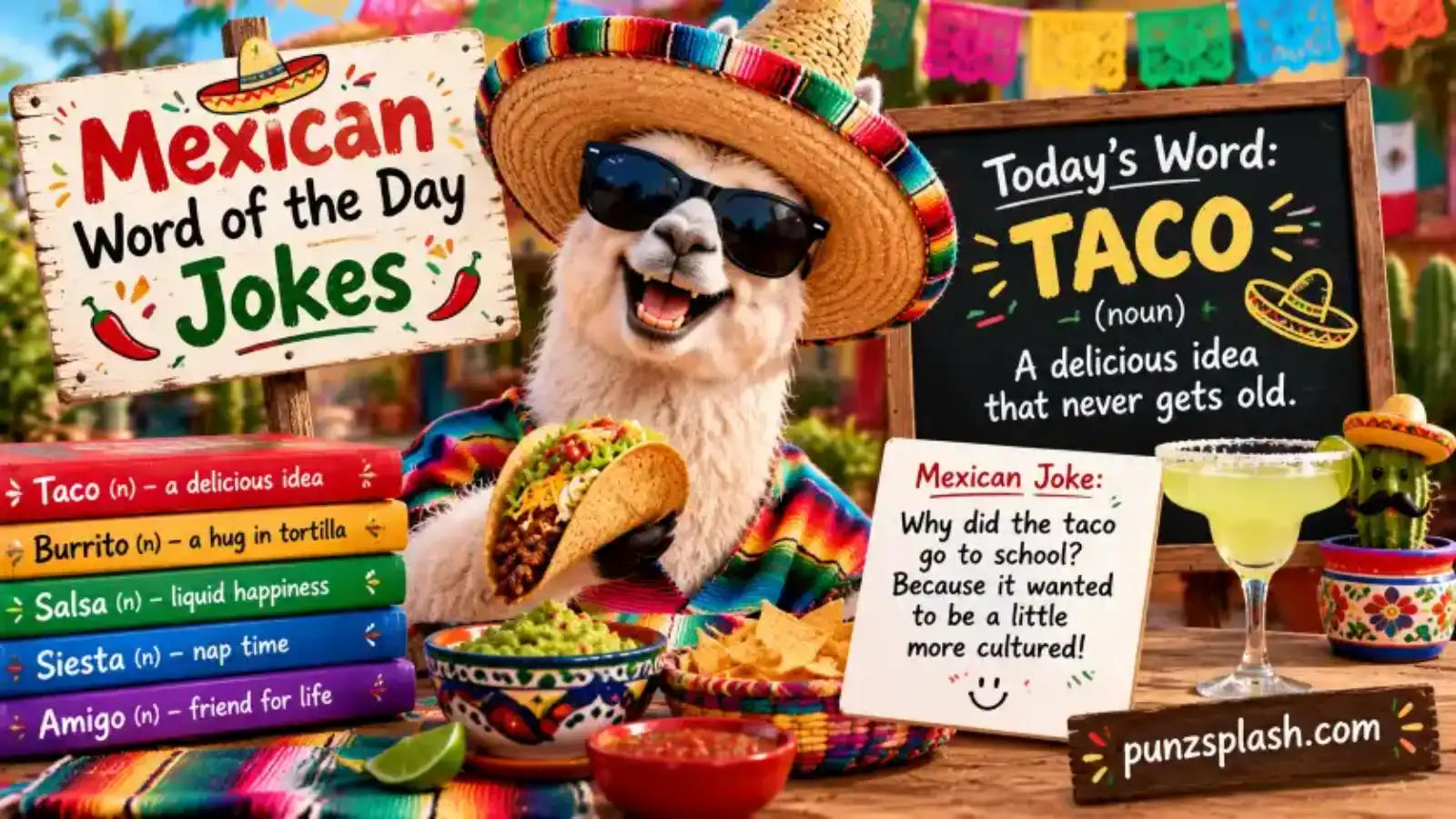
If you’ve ever heard someone announce a dramatic “word of the day” and then reveal a gloriously silly pun, you already know the basic joke format. Mexican word of the day jokes play with Spanish-sounding words, English phrases, names, and pronunciation to create quick punchlines.
The best versions are playful rather than mean. They joke about language confusion, literal translations, and unexpected word sounds—not about Mexican people or Mexican culture. Here’s a collection you can use for laughs, captions, texts, classroom-friendly humor, or a silly conversation starter.
What Are “Mexican Word of the Day” Jokes?
The phrase usually refers to a pun-based joke format involving Spanish words or Spanish-sounding expressions.
A typical joke sets up a fake “Spanish word of the day,” gives it a funny pronunciation or meaning, and ends with a punchline that sounds like an English phrase.
Think of it as a tiny comedy lesson where the grammar is questionable but the commitment is excellent.
Quick tip: These jokes work best when the punchline is obvious enough to get quickly. If you need five minutes to explain the pun, the joke has already filed for retirement.
Funny Mexican Word of the Day Jokes
Here are some original, lighthearted examples built around wordplay and pronunciation.
Word of the day: “Sombrero.”
Meaning: A hat with enough confidence to become the main character.
Word of the day: “Taco.”
Meaning: The official food of people who say, “I’ll just have one.”
Word of the day: “Nacho.”
Meaning: What you call someone else’s food when you’re trying to steal it.
“Those fries are nacho fries? Interesting. They are now mine.”
Word of the day: “Burrito.”
Meaning: A meal that starts as lunch and somehow becomes a sleeping bag.
Word of the day: “Queso.”
Meaning: The reason chips suddenly become impossible to stop eating.
Word of the day: “Guacamole.”
Meaning: Green dip with a mysterious talent for disappearing at parties.
Word of the day: “Fiesta.”
Meaning: A party where the snacks seem to have their own attendance record.
Word of the day: “Salsa.”
Meaning: A sauce that can turn a peaceful snack into an adventure.
Word of the day: “Piñata.”
Meaning: A colorful container that teaches children about delayed gratification.
Word of the day: “Amigo.”
Meaning: Someone who says, “I know a place,” and suddenly you’re on a three-hour food mission.
Short Word-of-the-Day One-Liners
Sometimes the setup is funnier when it takes two seconds.
- Spanish word of the day: Taco. English translation: “I need another one.”
- Word of the day: Salsa. Definition: dancing sauce.
- Spanish word of the day: Nacho. Translation: apparently not yours.
- Word of the day: Fiesta. Definition: a party with excellent snack support.
- Spanish word of the day: Queso. Translation: cheese, but make it dramatic.
- Word of the day: Burrito. Definition: a tortilla with big ambitions.
- Spanish word of the day: Sombrero. Translation: instant shade with style.
- Word of the day: Piñata. Definition: a colorful mystery box with a very short future.
“Nacho” Jokes
Nacho is especially useful for English wordplay because it sounds like “not your.”
Why did the tortilla refuse to share the chips?
Because they were nacho chips.
What did the chef say when someone reached for his plate?
“Those are nacho tacos.”
Why did the kid guard the cheese dip?
Because it was nacho queso.
What did the hungry friend say about the last burrito?
“That’s nacho burrito… until I eat it.”
The joke is intentionally based on the sound of the phrase rather than claiming that nacho literally means “not your” in Spanish.
Taco Wordplay That Actually Works
Tacos are almost unfairly easy to joke about.
My taco told me a secret.
It said, “Lettuce keep this between us.”
I asked my taco if it wanted to go out.
It said, “Shell yeah.”
Why did the taco get promoted?
It had excellent filling potential.
What does a taco say when it wins?
“Guac and roll!”
Why was the taco so calm?
It knew how to keep things wrapped up.
My taco started a podcast.
Every episode was about filling the silence.
Spanish-Sounding Puns for Text Messages
These work well when you want something quick enough to send without turning the chat into a comedy special.
“Spanish word of the day: taco. I have learned it means ‘bring me another one.’”
“Word of the day: fiesta. I’m fluent enough to know I should bring snacks.”
“My Spanish vocabulary is growing. Mostly around the food section.”
“Today’s Spanish lesson: queso. Tomorrow’s lesson: why I ate all of it.”
“I’m studying Spanish one taco at a time. My grades are delicious.”
“I know several Spanish words. Unfortunately, most of them are things I want to order.”
Fake Dictionary Definitions
A good word-of-the-day joke can sound like a tiny dictionary entry.
| Word | Totally Serious Definition | Example |
|---|---|---|
| Taco | A folded edible masterpiece | “I ordered one taco and accidentally joined a taco party.” |
| Salsa | Dancing sauce | “The salsa was spicy enough to make me dance.” |
| Nacho | A warning that food belongs to somebody else | “That is nacho pizza.” |
| Burrito | A tortilla-based food blanket | “I became one with the burrito.” |
| Queso | Cheese capable of controlling decisions | “I wasn’t hungry until I saw the queso.” |
| Fiesta | A gathering powered by food and music | “The fiesta started when the snacks arrived.” |
| Sombrero | Portable personal shade | “This hat has excellent weather-management skills.” |
Clever Spanish Wordplay
Not every joke needs a big punchline. Sometimes the humor comes from twisting an ordinary phrase.
I tried learning Spanish through food.
It was a pretty well-rounded diet.
My Spanish teacher asked me to use “taco” in a sentence.
I said, “Taco ’bout a great lesson.”
I wanted to learn Spanish quickly.
Then I discovered that language skills take longer than ordering lunch.
I bought a Spanish dictionary.
It was a great read, but the plot was difficult to translate.
I asked whether my Spanish was improving.
My teacher said, “Mucho.”
I said, “Thank you. I was hoping for a slightly longer answer.”
Wholesome Mexican Word-of-the-Day Humor
Language jokes are more enjoyable when they celebrate the fun of learning instead of making someone the punchline.
Spanish word of the day: “Amigo.”
Meaning: a friend.
Example: “A good amigo will tell you when you have salsa on your shirt.”
Spanish word of the day: “Familia.”
Meaning: family.
Example: “Familia is the group chat that somehow contains 47 messages before breakfast.”
Spanish word of the day: “Gracias.”
Meaning: thank you.
Example: “Gracias to whoever brought tacos.”
Spanish word of the day: “Comida.”
Meaning: food.
Example: “I studied this word very seriously.”
Spanish word of the day: “Fiesta.”
Meaning: celebration.
Example: “The party began when someone mentioned snacks.”
Mexican Food Jokes for Captions
Looking for something short for Instagram, TikTok, Facebook, or a photo caption?
- Taco ’bout a good day.
- Shell yeah, it’s taco time.
- Guac this way.
- Nacho average lunch.
- Queso happy right now.
- Let’s taco ’bout it later.
- Powered by tacos and questionable decisions.
- Good mood, great food, extra guac.
- Current status: emotionally attached to queso.
- Life is better with a little salsa.
- I came. I saw. I ordered tacos.
- No thoughts, just tacos.
Are These Actually Spanish Translations?
This is where a little accuracy matters.
Many jokes in the “word of the day” genre are English puns that borrow Spanish vocabulary or imitate the sound of Spanish. They aren’t genuine translations.
For example, “nacho” is commonly used in jokes because it sounds like “not your.” But nacho in Spanish is not a general translation of “not your.” Likewise, jokes that invent meanings for words such as taco, salsa, or burrito are meant to be humorous rather than educational.
That distinction is worth keeping in mind if you’re using these jokes in a Spanish-learning setting.
A Better Way to Use Them
If you’re teaching or practicing Spanish, pair the joke with the real meaning.
For example:
Spanish: taco
Real meaning: a taco
Joke: “Taco ’bout a delicious lesson.”
That way, the humor adds personality without turning a pun into a fake language lesson.
A Few Dad-Joke Favorites
Dad jokes have one important rule: the worse the pun, the more confidently you deliver it.
Why did the taco bring a jacket?
Because it heard there was going to be a chili night.
Why did the burrito go to school?
It wanted to become a wrap star.
Why did the tortilla apply for a job?
It wanted to make some dough.
Why did the salsa win the talent show?
It had the right moves.
Why did the queso get invited to every party?
It was always grate company.
What did the taco say after making a mistake?
“Let’s not taco ’bout that.”
Mexican Word-of-the-Day Jokes for Kids
For younger audiences, keep the humor simple and friendly.
What did the taco say to the cheese?
“You make everything cheddar.”
Why did the tortilla smile?
It was having a wrap-tastic day.
Why did the salsa dance?
It had good moves.
What did the taco say before dinner?
“Shell we eat?”
Why was the burrito so comfortable?
It was all wrapped up.
What did the cheese say to the chips?
“You complete me.”
Why Wordplay Is So Funny
The brain enjoys a little surprise.
A word-of-the-day joke usually sets up one expectation and then suddenly changes the meaning. Your brain starts down one path, notices the sound or double meaning, and makes the connection.
That’s why these jokes often work best when they’re short.
A simple formula is:
Setup → familiar word → unexpected interpretation → punchline
For example:
“Spanish word of the day: nacho.”
The listener expects a definition. Instead, the joke turns the sound into an English phrase.
The comedy comes from the switch.
Make Your Own Word-of-the-Day Joke
Want to invent one instead of borrowing someone else’s?
Start with a real Spanish word that has a useful sound, meaning, or association in English. Then build a harmless twist around it.
Try this creative challenge:
Spanish word: taco
English sound: “talk”
Possible setup: “Today’s Spanish lesson is taco.”
Punchline: “We’re going to taco ’bout it.”
Or:
Spanish word: queso
English association: “cheese”
Punchline direction: exaggerate how important cheese is.
The trick is not to force every Spanish word into an English pun. Some words simply refuse to cooperate—and honestly, that’s part of the fun.
FAQs:
What are Mexican word-of-the-day jokes?
They’re usually short jokes built around Spanish vocabulary, Spanish-sounding words, pronunciation, or playful fake translations. The format is commonly used for quick puns and one-liners.
Are these jokes real Spanish?
Not always. Many are English-language puns, not accurate translations. If you’re learning Spanish, check the actual meaning of a word before treating the joke as a language lesson.
What is a famous example of this type of joke?
The “nacho” pun is one of the most recognizable. It plays on the similarity between nacho and the English phrase “not your,” as in “That’s nacho cheese.”
Are these jokes appropriate for kids?
Yes, when they focus on harmless wordplay, food, pronunciation, or language-learning humor. The examples above are designed to stay light and family-friendly.
Can I use these jokes on social media?
Absolutely. Short taco, queso, salsa, and nacho puns work especially well as captions because they can be understood quickly.
How can I make a better word-of-the-day joke?
Use a familiar word, keep the setup short, and make the punchline easy to understand. Avoid relying on stereotypes about Mexican people or culture; language-based humor is usually funnier and more original anyway.
Final Thought:
The charm of a “Mexican word of the day” joke isn’t really about pretending to teach Spanish. It’s the tiny surprise of taking a familiar word and giving it an unexpected English twist.
So use the format for what it does best: quick laughs, silly captions, dad-joke energy, and playful language practice.
And if today’s lesson is taco, remember the most important rule:
Always study hard. Especially when the homework comes with extra guacamole.
